
Britt and Today
Kings and queens of the road
Honorary crowns at Britt’s National Hobo Convention—coffee cans, applause, Steam Train Maury, and the living roster of Hobo Kings and Queens.
A shredded coffee can sits on a head while a Main Street crowd claps. No oath. No bylaws. The title is real in the way Britt is real: ritual, memory, and a town that still sets a place each August.
The previous room traced how Tourist Union No. 63 and Britt’s 1900 yes became an annual National Hobo Convention. This room stays with the crowns. Who is Hobo King or Queen? How does a crowd decide? What did Maurice “Steam Train Maury” Graham do with five reigns and a Grand Patriarch title? Which other names are pinned to verified years? And how does the convention still work when fewer people arrive by freight? Pair every parade story with the safety coda in Then and now—heritage, not a boarding lesson.
What the titles are
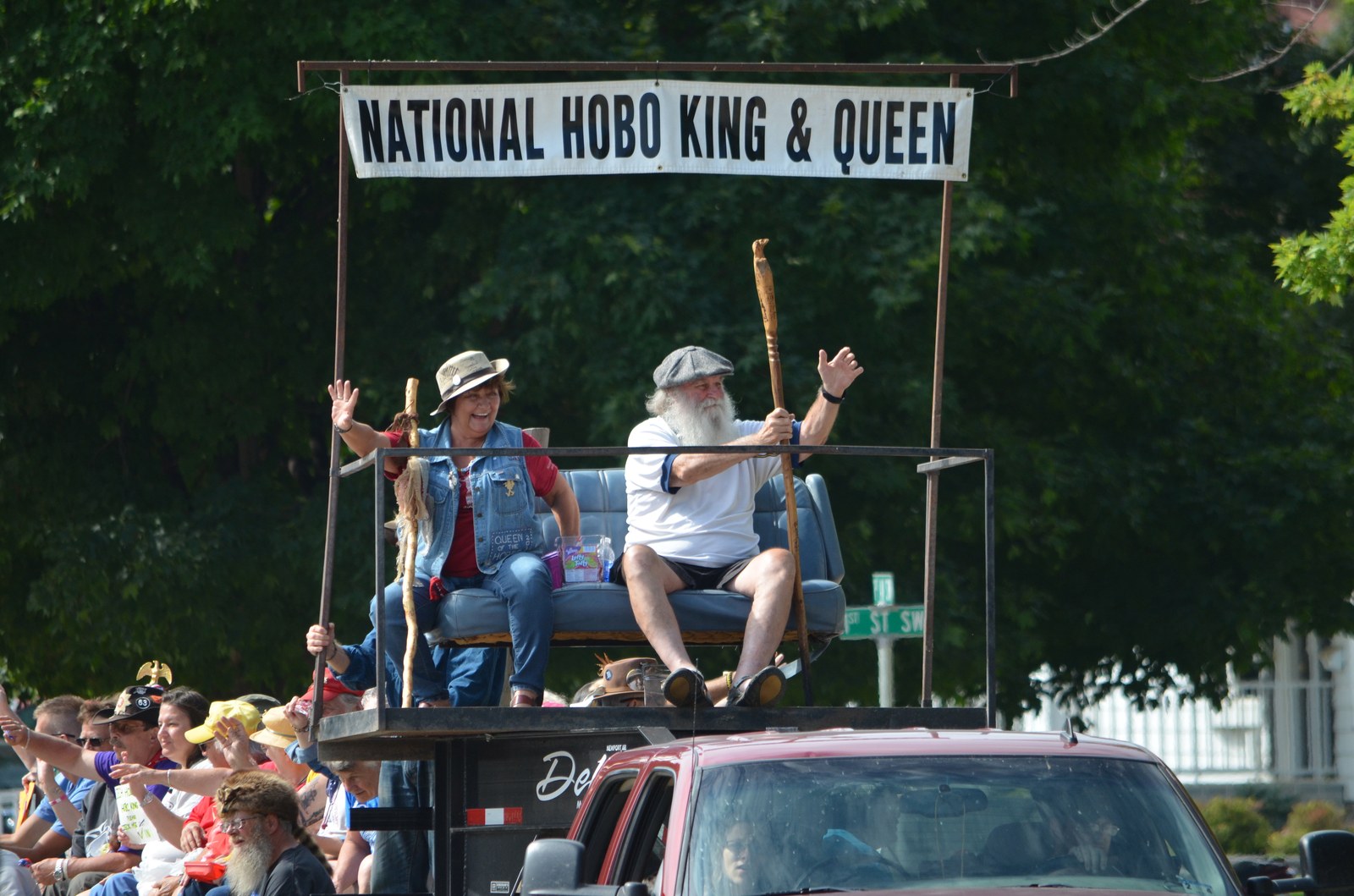
Hobo King and Hobo Queen are honorary titles crowned at the National Hobo Convention in Britt, Iowa. They do not create a government office, a guild with dues, or a legal membership. Period and later reporting agree that the ceremony is the point: a short speech, song, or story; a crowd’s acclamation; a tin crown; sometimes a cape. The titles honor people the gathering recognizes as carrying road memory—whether they still ride freights, arrive by highway, or keep the lore alive from a settled home.
Britt’s first National Hobo Convention ran on August 22, 1900, after Tourist Union No. 63 accepted a civic invitation (walked in detail in Tourist Union No. 63). The gathering then largely lapsed in Britt until 1933, when Depression-era revival made the convention annual (interrupted in wartime). Iowa and wire-service summaries place the annual footing in 1933; UPI’s 1982 Britt dispatch put the same date in a single line: Britt staged the first convention in 1900, “but it was 1933 before it became an annual event.”
The 1933 revival already used coffee-can regalia. Iowa accounts of that year’s king, Hairbreadth Harry, describe a crown fashioned from coffee cans and a red cape. Later decades kept the joke-and-honor in one object: a coffee can cut or shredded into a crown. Iowa reporting on more recent kings names a Folgers coffee-can crown specifically; 1980s wire copy more often said simply “coffee can.” Either way, the metal is pantry metal—not gold.

How the vote works
Contestants stand before the crowd and give a short nominating turn—speech, song, or story. Spectators choose by applause or acclamation. UPI’s Britt coverage in the early 1980s is blunt about the method: winners “are selected by applause after contestants make a short speech” (1982); titles are “affirmed” in a competition “based on applause for each candidate’s three-minute speech” (1984); “contestants tell or sing their nominating speeches and spectators pick the new king and queen by acclamation” (1985).
Close races go to runoffs. In 1985, UPI reported that Frisco Jack—a tramp “from someplace in Pennsylvania,” a cable splicer who made wire rings for other travelers—survived two runoff votes against Ramblin Rudy of Illinois and Sparky Smith of Iowa before taking the coffee-can crown. Defending king Fry Pan Jack declined to defend. The same dispatch notes Frisco’s restlessness after crowning: told to stay for photographs, he answered that he did not stay two hours anywhere.
Steam Train Maury Graham
Maurice W. Graham (1917–2006)—known on the road and in Britt as Steam Train Maury—is the best-documented modern Hobo King. The New York Times obituary (23 November 2006) records his five Britt crowns in 1973, 1975, 1976, 1978, and 1981; his anointing as Grand Patriarch in 2004 (the paper called him the first and only Grand Patriarch of the Hobos); and parallel honorifics such as Life King of the Hobos East of the Mississippi. He was a founding member of the Hobo Foundation and helped establish the Hobo Museum in Britt—the brick cases walked in Britt today.
Born June 3, 1917, in Atchison, Kansas, he hopped freights as a teenager in the early Depression, later worked as a cement mason and Army medical technician, and returned to the road in later life. In 1982, UPI found him at Britt retiring from the king competition after those five wins, planning a Toledo winter “if my wife lets me in,” and still teaching the crowd what a hobo was not: not merely a bum, but someone who had served time learning the life.
His public image matched the quote: overalls, bright red kerchief, floppy hat, feathers and buttons—the costume UPI said made “first impressions” in the hobo business. In 1990 he published Tales of the Iron Road: My Life as King of the Hobos (Library of Congress name authority and contemporary obituaries agree on the title). He died November 18, 2006, in Napoleon, Ohio, near Toledo, at 89, after strokes. Britt keeps his name in museum cases and memorial culture; confirm burial versus commemorative marker locally, as Britt today already warns for all famous road names.
Other verified royalty
A full reign list would require Britt’s own ledgers year by year. This museum prints only names and years pinned by reputable wire, civic, or archival sources—and leaves undated “famous king” folklore in the cases at Britt.
- Long Looker Mic (Iowa) — UPI, 3 August 1985: her eighth queen’s crown since 1971, and the first since 1982; she called it the sweetest and promised to promote hobodom on the road.
- Frisco Jack — UPI 1985: king after two runoffs; coffee-can crown; wire rings for fellow travelers.
- Fry Pan Jack — UPI 1984: king affirmed by applause on a three-minute speech; held the title temporarily after Mountain Dew’s death earlier that year; declined to defend in 1985.
- Mountain Dew (Illinois) and Hobo Lump (Memphis, Tenn.) — UPI 1983: king and queen; Maury spoke for Mountain Dew after surgery; Hobo Lump persuaded by the crowd to serve again.
- Slow-Freight Bonita — UPI 1984: Queen of the Hobos.
- Connecticut Shorty (Betty Moylan), daughter of road man Connecticut Slim — crowned Hobo Queen in 1992; remains a public preservation voice (University of Iowa Hobo Archive; Smithsonian Britt reporting). Her sister New York Maggie appears with her in the UI women-hobos exhibits.
- Minneapolis Jewel (Julianna Porrazzo-Ray) — queen in 1986, 1991, 1997, 2011, and 2017; in 2017 she and her husband Tuck were named queen and king together (regional profile cited on this museum’s Sources page).
Other Britt names—Pennsylvania Kid, Hard Rock Kid, Fishbones, Would-Be Hobo—appear in museum cases, Los Angeles Times Britt color, and memorial lists. Attach a year before treating any of them as a dated reign in this room.
Hobos today
Who still comes to Britt? Smithsonian reporting from a recent jungle still finds riders who know freight cars beside hobbyists, historians, and fans. A University of Northern Iowa field study of the convention distinguished older travelers who now move mostly by truck, car, or RV—sometimes calling themselves rubber tramps—from younger people still drawn to train culture. Heritage families return for coronations and memorials. Local volunteers keep the stew pots and the parade moving. The culture survives through the Hobo Foundation’s legacy, the Britt Hobo Days Association, the National Hobo Museum in the old Chief Theater, oral history at the University of Iowa Hobo Archive, and every August’s choreography: jungle fire, Friday memorial at Evergreen Cemetery’s National Hobo Memorial section, Saturday parade, free mulligan by the vat, and king-and-queen speeches. Those year-round landmarks are mapped in Britt today.
Riding freight without authorization is illegal trespassing and remains dangerous—faster trains, sealed cars, hardened security. This museum documents the harvest-circuit labor force and Britt’s living ritual; it does not teach boarding.
Coffee-can crowns are one August ritual; the museum, cemetery, and Hobo Days calendar are how Britt keeps that ritual public year-round. Next room: Britt today.
Sources for this room
- Douglas Martin — “Steam Train Maury, 5-Time Hobo King, Is Dead at 89”
- Library of Congress Name Authority — Graham, Maury, 1917–2006
- UPI — “Economy boosting the hobo ranks”
- UPI — Mountain Dew / Hobo Lump (1983); Fry Pan Jack / Slow-Freight Bonita (1984); Frisco Jack / Long Looker Mic (1985)
- The Gazette (Cedar Rapids) — Iowa Hobo King / Folgers crown
- Bill Holm — “Britt’s First Convention”
- University of Iowa Hobo Archive — women hobos / Connecticut Shorty & New York Maggie; Minneapolis Jewel
- Smithsonian Magazine — “The Last of the Great American Hobos”
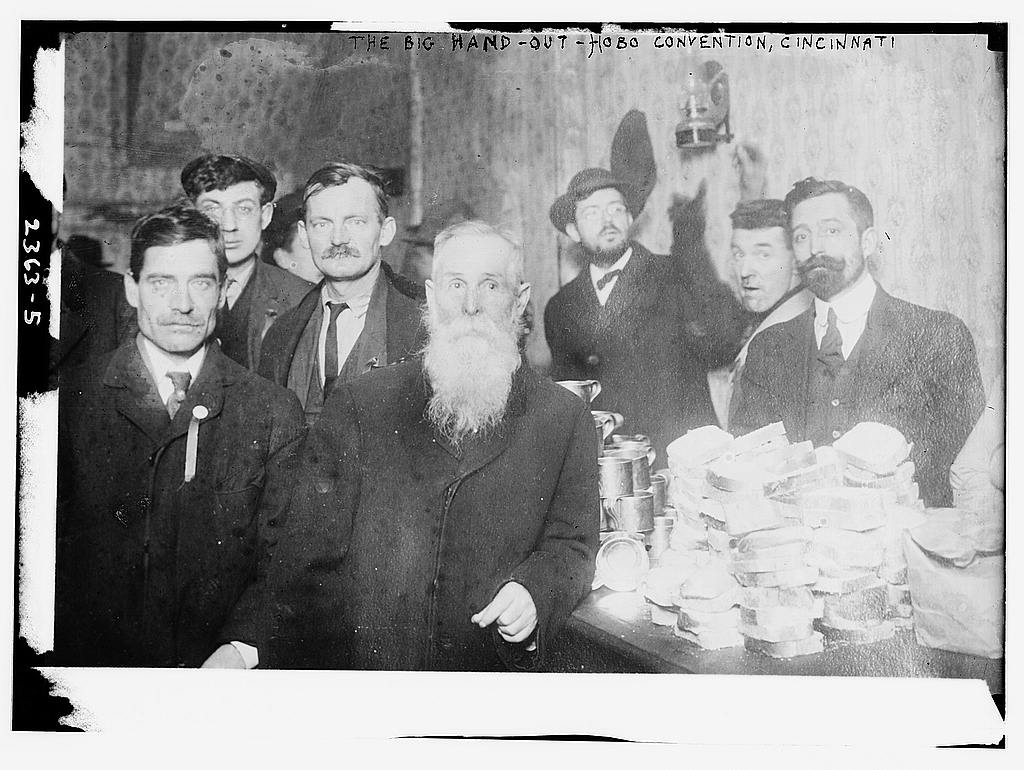
- Library of Congress — Bain News Service, “The Big Hand-Out” (Cincinnati Hobo Convention food handout, 1912; item 2014690092)
See Sources for the wider Britt, Foundation, and Tourist Union bibliography.